Piracy vs. Purchasing: Who’s Right?

The discussion of the ethical grey area of piracy is in no way a new conversation. For as long as people have created art, other people have tried to fashion a way to get it for free. Piracy as a headline-making crime, however, gained attention with the advent of free music downloads, most notably with the Napster’s popular free service in the late 90s. Now, personally, this is not a subject I have really followed closely over the years. I remember the crazy court cases involving members of Metallica and Pearl Jam and I watched with mild shock as teenagers were prosecuted for piracy.

I guess I never really formed an opinion on the topic; most likely because I never engaged in Internet piracy. I don’t currently download pirated movies, books or movies. I have never really examined my motives for the lack of engagement in this 21st century past time. Pretty much, I’ve just been a combination of lazy and scared. I’m the one who will get caught and I’m too short for prison. Not to mention, I’m much too lazy to figure out how to even go about it.

Does this mean I’m innocent of piracy? Certainly not. I have bootlegged albums, movies, etc that friends have given me over the years, and I’m more than happy to take free art off their hands. But if forced to pick a side…well, I just don’t know.

I did some cursory research on the topic, and what interested me most was that a good deal of the articles and/or blogs written about piracy vs. purchasing have everything to do with royalties and industry income. People argue back and forth on whether or not the music industry will come to a grinding halt as a result of Internet piracy. I think enough time has passed now that we can all agree this will NOT be the case. The amount of money that labels are losing is really negligible, it seems. And truth be told, maybe it’s time we do away with labels for the most part anyway.

My understanding of the fiscal breakdown is that a record label takes the biggest chunk of the money made from albums sold; presumably because the label is responsible for the artists’ work making it to the hands of the public. It is, in fact, a giant machine. The bigger the machine you climb onto, the bigger the potential profit. The problem, however, is that signing with a label is a gamble. They invest hundreds of thousands of dollars into a band with the stipulation that the band will pay them back via royalties.

In essence, major labels are loan sharks. So, if the band is totally convinced that the gamble will pay off, then perhaps this is the best route to follow. The problem, and this is the part of the conversation I really don’t see a lot of, is that once a band signs with a label, they lose most (if not all) creative freedom. Most labels aren’t focused on creating good art, they are focused on making money. So if a band is in the “fair to middlin'” arena and signs with a label, they could lose out on the chance to have a career in music altogether. If their album sales don’t match the label’s financial output, then the band will undoubtedly be dropped. If these same middle of the road bands self-promoted via the Internet with the ultimate goal of just “making a living,” then perhaps we would see more bands rise to moderate popularity. In order for this to be achievable, however, the buyers have to respect the art enough to pay for it.

When push comes to shove, the conversation needs to steer away from money and head towards respect for art. With the above scenario in mind, I believe that ideally we, the purchasing society, would be able to create a system in which music labels (of which I have a pretty low opinion) went the way of the rotary phone. With the increasing usability of the Internet, there is absolutely no reason that a perfectly talented band shouldn’t be able to make a decent living producing art. That means, though, that we the fans need to start coughing up some dough. We like music (books, movies, etc). We like to be entertained. And for the greater population, we depend on the more talented set to take care of fulfilling these needs. The artists deserve money for their contributions to society- otherwise we will cease to have art. Imagine being a talented musician with only a few spare hours here and there to craft art. This is not the formula to advanced talent and skill. This is the formula for mediocrity.

If we the purchasing public continue to “steal” music, the bands will be forced to continue to hop on the industry machine. Really, it’s a sick sad cycle. I think one solution is that the people start paying the artists directly for the music and that the artists lower their expectations for income. Unfortunately, the egomaniacs of the world will likely never allow this to happen. The P.Diddy/Puff Daddy/Sean Johns need their Hummers and their Lambos and their mansions and their video girls.

For bands with the intention of producing art, though, maybe we could make this happen with a commitment to paying for the art we get. I remember interviewing Chris Hall back in the day. He had a great attitude. His band had had a couple of hits over the years; his attitude was that he was totally happy because he was able to do what he loved and he only had to make coffee for someone when he wanted to. If more fans paid for art and more artists approached their work as though it was a medium for expression rather than a route to fame, maybe we could do away with the corporate bullshit altogether. Just maybe we’d begin to see music and art with more integrity begin to rise up.
**http://www.music-law.com/musiccontracts.html

Found in Hase…Lost in Ginza…

After boldly crossing the street yesterday, I navigated my way back to the hotel and treated myself to a fancy dinner and a glass of wine. I wasn’t sure what was next on my agenda, so I got online (thank god for the internet) and started perusing options. Somewhere in the midst of links and pages, I saw something about “old Japan” just an hour out of Tokyo. It turns out some of the ancient Buddhas and shrines I so longed to see were safely ensconced in the small town of Kamakura. The train ride seemed easy enough, so I decided that would be my next adventure. After all, if I could cross the street and make it back safely, why not just leave Tokyo altogether for a day?
When I arrived on the platform for the train heading due south, I immediately noticed my new favorite toy – the “coffee vending machine.” While figuring out which type of coffee to buy and how much yen it might cost, a young boy with a cute Australian accent set about torturing his younger, stroller bound brother. I couldn’t help but giggle. The parents, with frustration, did their best to alleviate the sibling rivalry, and because strangers don’t outwardly acknowledge each other in such situations, I set about fiddling with my coffee and keeping my obvious amusement directed towards my feet. Eventually the parents apologized, to which I could only reply “Don’t worry, they’re brothers.” We began a conversation – where was I from, where were they from, etc, etc. It was such a relief to be engaged in an actual, verbal conversation. For three days I hadn’t really had a conversation. It turns out that Jon and Sara were on the same journey to Kamakura as I was – but they hadn’t really defined their plan. I shared what I had learned, and we decided to join forces for the day.
Before continue on with my story, I need to share an important lesson I learned: when the “next” train arrived, we all boarded. I was impressed! Spacious seating design, heat, available restrooms…it was even a ‘green’ train. John and Sarah were also impressed. They went to the back of the train, and I sat up front and started listening to my Zune. Soon, the usher came around asking for tickets. I handed mine over and she explained, as best she could in broken English, that I owed her an additional 2,000 yen. It turns out that, in Japan, contributing to an environmentally sound mode of transportation is pretty costly! I had mistakenly gotten on the “green” train for an unknown, unannounced extra charge…Not that keeping our planet green isn’t priceless, but I guess a warning would have been nice…”Warning: Green Train: $20, Saving the Earth?: Priceless…”
Anyway, after a peaceful hour on the train, we arrived in Kamakura. We left the train, and after a brief moment of confusion, we found the train to the Hase, the town where the Giant Buddha sits imposingly meditating. Another brief ride on a train reminiscent of the San Francisco trolley cars and we found ourselves in an authentically historic neighborhood of Japan. The cobble streets were narrow and winding and the sidewalks were scarcely wide enough for a pair to walk side by side. We were all easily distracted by the abundance of little curio shops – we adults maybe even more excitable and distractible than the kids. We stopped by a beautiful kimono shop where I was promptly scolded for taking pictures. I’m not totally sure why – it’s not as though I have any hope of EVER recreating any of it – but it was just so beautiful with its oranges, reds and yellows aflame and alive.
We walked a short, crowded path to the Giant Buddha. All my life I have wanted to stand before one of these massive structures – and I can tell you that it was no dissappointment. I am not sure how to describe it; Adjectives just won’t do. There before me was a massive statue, perfect in its artistry. But that wasn’t the part that left an indelible mark on me; the feeling of standing before a landmark that has been there for nearly 1,000 years…that is the part I simply can’t describe. The buildings that orginally existed around it were destroyed by typhoons and tidal waves…yet this massive giant stood immovable. The moment was breathtaking…solemn…unmatchable. So I had the only reaction I could have – I stood silent, mesmerized, enthralled. And then I pulled out my chikin hat and had my new friends photograph me and the travelling hat, because life is short and ever-so-serious if you let it have its way, and this simply will not do.
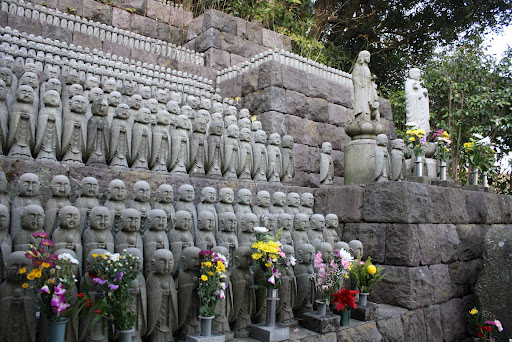
After the Buddha, the lot of us wandered back through Hase in search of the Hasedera, or the Hase Kannon Temple. Once again, I climbed my way to a breathtaking sight. Surrounded by Jizo, I felt a sense of peace and was overwhelmed with awe. Thousands of tiny steps meandered past thousands of tiny buddhas, and I walked through them all. A trip like this forces a person to confront relgious beliefs. I haven’t questioned my beliefs for years, and I don’t now. But one thing I realized was that if I have an opportunity to say a prayer for my loved ones, I will. I want good energy flowing through and around my friends and family as often as possible, so with yen jingling in my pocket, I tossed a few coins, lit some incense, and said a prayer for those I love. I can only hope that the winding wisps of smoke travelled far enough for my prayers to be heard.

Later, Jon and Sara treated me to a lovely Unagi dinner, after which we made our way back to Tokyo. We consulted our subway maps to figure out on which of the hundreds of stops we should disembark. We all agreed that Tokyo Station would be the best bet…and probably it was. But what I failed to anticipate was exiting the subway station only to find myself in the dead center of the Ginza shopping district. Basically, in the space of 72 hours, I went from the comfort and guaranteed orientation of a 30 square mile island to being hopelessly lost in the heart of what I can only compare to 5th Avenue in New York City. Oh, did I mention it was after dark? I wandered, freezing, hopelessly lost, finding myself without a soul who spoke English to guide me. After wandering up and down the same streets several times with no luck or direction, I decided to take a chance on the only store I could find sporting an American flag. Luckily the sales clerk at the Tokyo Louis Vuitton spoke enough English to direct me to the Tokyo Metro. Exhausted and past my bedtime, I arrived safely at my hotel.

excerpt from my journal: I can’t even explain how amazing this was. Towering, Imposing, Ancient, and yet Serene. How amazing to be standing in front of a statue that has been in National Geographic. Me. Cami. From Union. Of course, no one around me understood the significance…How did this happen? Is it wrong to be proud of my bravery? Maybe there’s nothing left for me to be scared of….